
Emergency Planning

Politicians seem to be waking up to the need to take serious and immediate action to mitigate the magnitude and effects of climate change. A recent run of bushfires, powerful hurricanes and typhoons, floods and record hot years have made it harder to argue that climate change isn’t now manifesting itself more regularly in the weather.

It also seems a pivotal moment in the intra-generational battle, with climate change denying boomers like Trump, Bolsano and Farage ranged against younger grassroots movements like Extinction Rebellion – typified in this clip from a recent BBC programme:

Against this backdrop, parties in the UK general election on 12th December will be making their pitch to govern the country for the first half of the roughly ten year period now emerging as the consensus date to deal with the risks before we enter the unpredictable world of a greater than 2C rise in average global temperatures.

In attempting to address these issues there are three inter-related dilemmas that parties will face – trading off meeting the emergency with inflation, immigration and other priorities. The big temptation will be for parties to ignore the dilemmas until forced to confront them, but unless confronted and answered early there is a big risk that ambitious plans to tackle climate will be derailed.

In framing this article I am of course not outlining the massive benefits and avoided costs associated with preventing uncontrolled climate change because these benefits occur in the long term, or accrue in the short term to parties other than the Government. To meet the challenge we must change the overall direction and drivers of the economy, which entails an upfront and immediate cost. If this wasn’t so, we’d have done it already. This isn’t an argument against taking action on climate change, merely recognising that the <strong>transition</strong> from a high to a no carbon economy is not cost free, especially as we have left it very late to start, and we need to plan to meet these costs if we are to succeed. Like most worthwhile investment, there is an initial cost to reap later and longer terms benefits.

The most recent set of recommendations on how to tackle the climate emergency in the UK has been made in the Labour Party commissioned 30 by 2030 Report (https://labour.org.uk/wp-content/uploads/2019/10/ThirtyBy2030report.pdf). The main thrust of the recommendations would be the same regardless of the party commissioning the report (although the resulting policies to deliver them may be radically different) – namely a massive retro-fit of housing to improve efficiency, completing the decarbonisation of electricity, and decarbonising heat. In addition transport, strangely muted in the recommendations, needs to be decarbonised.

All of these require massive capital investment, huge programmes of work requiring people, materials and resources, and large amounts of project management and policy focus. It’s the need to do these programmes in the short time available that creates the dilemma.

As an illustration, the cost of meeting decarbonising the economy by 2050 is estimated at 2% of GDP, which is the equivalent of the cost of Apollo programme to the US economy but carrying on for three times the ten years it actually lasted. Achieving the same goal in ten rather than thirty years will require a much greater adjustment more akin to the re-orientating of an economy in wartime, with the attendant higher Government direction of the economy.

The Capacity – Inflation Dilemma

The issue with trying to rapidly increase activity in any area, especially involving capital expenditure, is that you are going to need more skilled people and more resources than are immediately available.

If a business wants to expand capacity quickly, it has the option to acquire existing capacity belonging to someone else – not an option for a whole economy especially in an environment where most other developed countries are also increasing demand.

The speed of capacity growth required to meet the climate emergency challenge means coming up against real limits on the numbers of potential employees, skilled workers and manufacturing that exist in the UK economy.  Overall employment rates are low (albeit with many people under- rather than un- employed), there are already skills constraints in the construction industry, and the UK is not a global manufacturing leader in wind turbines, PV or building materials. A fast expansion of activity will lead to a premium being placed on all these things, and the scale of the expansion will mean this effect will be economy-wide.  For example electrical engineers will be diverted from the railways and other infrastructure into grid flexibility and renewables.

Capacity will respond to the increased demand, but there is a lag – it takes time to find and train the additional apprentices and engineers, time to set up new manufacturing and supply chains, and time to develop the project management infrastructure. There will always be a lag between the demand and the ability of the economy to meet it. The effect of this will be to increase inflation in the economy as a whole.

The dilemma for Government is how to respond to this. One option is to slow the rate of change so that capacity can grow organically in a less inflationary way, but this will increase the risk of missing the 2030 target. This leaves the three main levers used to control inflation:

  • Monetary policy – increase interest rates to reduce demand, although this will also affect the costs of meeting the climate emergency so may be partially self defeating. Interest rate rises might also be needed to prevent currency depreciation increasing the costs of imported materials.
  • Fiscal Policy – Higher taxes can be used to take the heat out of the economy.  Most people accept that taxes need to rise to pay for meeting the climate emergency, but if this is immediately invested in measures then the tax rises will be broadly fiscally neutral
  • Supply Side Reforms –These will undoubtedly be carried out to enable productivity and capacity increases in any case. The issue here is that the inflation problem is caused because supply side reforms cannot keep pace with the increased demand.

How Governments tread the line between keeping inflation at a reasonable level and meeting the 2030 deadline will be key to whether the target can be hit at all, and if it is whether the economy will suffer an extended hangover from its binge.

The Capacity – Immigration Dilemma

One lever that exists to overcome the lag between demand for new skilled workers and the economy’s ability to train them would be to source those workers from elsewhere.

This is a common solution to skills constraints – about one in eight nurses in the NHS have non-UK nationalities (https://researchbriefings.parliament.uk/ResearchBriefing/Summary/CBP-7783) and this fills the gap between demand and UK trained nurses. This is also a phenomenon that pre-dates the EU and freedom of movement – much of the UK’s canal and railway network was built by migrant Irish manual labour (the “navvies” were seen as such despite Ireland being part of the United Kingdom at the time).

In UK politics at the moment, migration is seen as a divisive issue. Large numbers of skilled migrant workers coming to work on large programmes of home improvement or renewables will increase the tensions across this division. Governments wishing to take advantage of the availability of skilled overseas workers will need to make the case for increased migration, and crucially plan to ensure that the benefits of using them is invested in ensuring that public services are equipped to support them.

The second issue with relying on workers trained overseas is that the climate emergency is not a UK specific problem. Many countries are gearing up to hit the 2030 target and these workers will command a premium. In fact a proportion of new skilled workers trained in the UK will prefer to seek higher premiums elsewhere.

Government will need to trade off the benefit of using overseas skilled workers to ease capacity constraints with the political cost of doing so. It’s clear that meeting the climate challenge requires Government making a strong positive case for more immigration.

The Climate – Everything Else Dilemma

However Government chooses to tackle the climate emergency, any credible plan will involve a large commitment of resources and materials to succeed. It will also need focus – high level policy will need to be translated into detailed policies and legislation, frameworks and processes. Many questions of detail will need to be considered and answered for policy objectives to be delivered.

Labour’s People’s Power plan addresses just one of the 30 recommendations but as my last three posts show, there is a lot of detail to be worked through to make the policy a success.

The small scale FIT scheme was implemented in a hurry by a Labour administration concerned about losing power before the scheme could be introduced. Consequently the scheme lacked stabilisers to correct the tariffs, had unclear rules on compliance and was open to gaming by unscrupulous operators. Much of the scheme’s design was overhauled by the Ofgem and the subsequent Coalition Government.

All this is to say that large and ambitious programmes have an overhead of political and organisational time required to ensure the scheme designs are well thought through, and sufficient resource in implementation to ensure that problems that arise can be solved effectively. The time required grows with the speed and ambition of the programme.

However, for a Government political focus is a finite resource, and spread too thin will mean a lot of things will be delivered badly and inefficiently. Parliamentary time is also a finite resource.

Governments will need to prioritise their focus.

The challenge for Governments faced with the climate emergency, and a recognised under investment in other services  such as health, education, social care and defence / security is that hard choices will need to be made about where finite ministerial and Government time is spent.  An incoming Government will need to be clear where its priorities lie – it’s a recipe for failure to have large ambitious programmes in all parts of Government if there are no identified priorities for when conflicts inevitably arise.  Politically of course it will also be challenging to make the case that legislation enabling wider roll out of, say, PassivHaus building standards should be prioritised over legislation delivering a policy objective in health.

Kicking the Can

These three dilemmas are real and will quickly manifest themselves for any incoming Government serious about tackling the climate emergency.  In evaluating the manifestos of the parties, now all published, we should be asking ourselves two questions –

  • is what they propose enough to meet the targets and the challenge
  • have they the clarity of thought to make the tough decisions and trade offs required – will they have the focus?

With manifestos published we can begin to judge whether our aspiring governments are up to the job.
Power to the People – Part 3 – Revenue

I’ve previously written about the scale and ownership model of Labour’s People’s Power Plan. In this last post on the subject, and in advance of seeing the general election manifesto for the parties I’m going to look at why the open question of revenue model matters for their plan

Currently offshore wind construction is supported by the CFD mechanism. This has been successful in driving down the costs to the taxpayer and in bringing forward investment, whilst construction and technology development risk sits squarely with the developer. Labour’s plan for the future of the CFD is unclear and there is no comment on how it will sit alongside the new ownership model.

This matters because it determines where key risks in the new scheme sit.

In the current model of the CFD, the fixing of the strike price through auctions ensures competition between developers and technology – especially with the reluctance of the current Government to use maxima and minima to carve out volumes for emerging technology. The effect of this was seen dramatically in the results for the third round CFD auction where strike prices for offshore wind were lower than those accepted in the Round 2 auction, and where Remote Island Wind came in well below the administrative strike price.

If Labour plans not to use the CFD, then not only will taxpayers’ money be exposed to market price risk but returns for minority shareholders will also become less certain. It’s hard to see how Labour will both justify taking this risk with its own money and increasing the risk for private investors, so some revenue stabilisation mechanism will be required. Watch this space.

Once prices are set through the auction, the distribution of risk is clear – construction, technology and development risk sits with the developer as their revenue is fixed by the CFD with no adjustment for delays and cost overruns; and market price risk sits with energy consumers through the difference mechanism. This division of risk means developers can manage the risks within their scope and use the certainty offered by the CFD to bring lower cost capital into the project (including using leverage). The energy market price risk is passed back to end customers via their energy supplier, in part offsetting their exposure to energy price risks (as the energy market price rises, increasing customer bills, the size of the difference payment shrinks, lowering the CFD supplier charge on their bills, and visa versa).

This model has brought forward significant investment in offshore wind, limited by the size of the budget for each allocation round.

If Labour plans to retain the CFD, the main change to this division of risk is to expose taxpayers to construction, technology and operational risk by becoming the controlling shareholder in each project. The pay-off is that the Treasury then accesses dividends over the life of the project. As I asked in Part 2, is this an appropriate use of taxpayers’ funds, and an appropriate risk for Government to take on?

There is also the question of how a Government which has a 51% stake in all bidding offshore projects might influence bidding strategies into an auction. Would they be tempted to set prices low or favour projects for non-economic reasons? How will this affect other non-Government invested technologies such as Remote Island Wind and ACT? How would this sit with State Aid and Competition rules (still required in some form post-Brexit)?

If a Labour Government doesn’t wish to retain the CFD, then market risk is transferred away from end users to taxpayers (through the 51% Government shareholding) and to the minority shareholder. This increases the risk profile for the minority shareholder and will affect the sources of capital open to them. How would renewable developers react to this, especially as they are already required to give up a majority shareholding?

Hanging over the entire question of the revenue and ownership model is whether the existing CFD could bring forward the same volume of projects without risking taxpayer’s capital? After all the last auction excluded several large projects (Moray East 2, Lewis, Viking) simply because the budget envelope was too parsimonious. Would the more simple route to securing the required 35GW of offshore capacity be to increase the budget and frequency of the existing auctions?

In summary the new ownership and revenue models behind Labour’s policies leave a lot of questions to be resolved and uncertainty for developers and owners. If we are to bring forward 35GW of offshore capacity before 2030 then these questions will need to be answered quickly if uncertainty isn’t going to make achieving these targets harder.

Of course there are even larger questions hanging over the Conservative Party’s plan for tackling climate change. Current Government policy is largely carried over from the May Government, with only a very vague single paragraph on “environment” in the Queen’s Speech.

In the next few weeks, election manifestos will be released and perhaps we’ll be able to understand each party’s approach.

Power to the People – Part 2 – Ownership

I recently wrote about the challenge faced by Labour in delivering their “People’s Power Plan” in terms of its scale and reach. One of the other interesting aspects is the new ownership model. Here are some thoughts.

If Labour intends to buy into existing development projects, what is the basis on which they will do that? Would they compel existing project owners to offer up 51% for sale? If so for what price, when and on what terms? The least disruptive model for this would be for these transactions to be for full market price – but with early stage development projects this will be hard to establish without earn outs. A worrying clue is in the more detailed policy on energy networks where it’s clear Labour expect the price to be set by Government, with a hefty list of deductions from a starting point of book value. If you think this suggests expropriation you’d be right – and unless more reassuring noises are made expect investment in development projects in UK waters to be more cautious as a Labour majority government becomes more likely.

A stake of 51% gives the Government control, so what do they want to use this control for? This will be a key question for any incoming minority investor. If Labour wants to direct decisions about placing work for construction or O&M, perhaps with an industrial policy in mind, then this presents additional risk. Would they also want to place restrictions around how funding was made into the project, or the tax structure or choice of main contractor? Neither Labour nor the Government have any direct experience of building and operating offshore wind farms so the balance of control will be key for large developers interested in participating. It’s easy to see a large number of reserved matters being demanded in Shareholder Agreements to protect their interests.

As well as needing to account for minority shareholder rights, being the major shareholder also means finding the majority of the money – and offshore wind is expensive, especially as sites move into deeper waters. 35GW worth of offshore is a major economic commitment from a Labour Party already committed to spending an estimated £196bn on nationalisation as well as large sums on social investment. At current construction costs of £2.5m/MW the total cost of an additional 35GW of wind would be in the order of £87bn with the public sector needing  £45bn in capital investment (there will be reductions as technology advances but this will, to an extent, be offset by more challenging sites). Where is this investment going to come from?

In practice, funding investment from general taxation or Government borrowing runs up against natural limits (where markets begin to demand higher returns on Gilts as borrowing increases above a level markets are comfortable with). This means that some capital rationing is needed – and energy will be hard to prioritise over health, education and so on. This was one of the issues with British Rail – it wasn’t badly run but starved of adequate investment by successive governments who had borrowing limits and other priorities

Also relevant is how the minority partner finances their share – traditional leveraging models can’t be used as the Government will not want to use commercial debt (as it will be able to raise funds more cheaply via the Treasury) and won’t want any leverage from their partner to find their way onto the Government’s books. This means that more novel financing solutions will need to be found by investors who do not want to take full equity exposure (for example, to introduce leverage at a Holdco level). Whilst not an insurmountable problem this will take time to develop as a standard and will introduce complexity and cost.

The last point to make on the ownership model is to ask why Labour feels it would be appropriate to invest public money and take development, construction and operational risk. These are the very risks that the current CFD model insulates taxpayers from and it continues to be the case that Government doesn’t have the skills to manage such risks.

Which leads us to the next issue – for Part 3 – of what the revenue model will be for these new assets, and how it will interact with ownership?

Power to the People – Part 1 – Scale

With less fanfare than they hoped (Brexit still sucking the political oxygen from the room), Labour have launched a new policy called the “People’s Power Plan” promising a radically new model for delivering renewable energy. There isn’t a detailed policy at the time of writing so only the outline headlines are available, and what headlines they are: 

·         up to 37 new offshore wind farms bringing the total to 52GW of power by 2030

·         51% Government ownership of these new wind farms

·         20% of the profits from the public ownership being used to invest in left behind coastal towns

These targets raise many questions – the success or otherwise of this policy is in the detail – but here are some areas to think about, starting with the scale of the proposal:

The UK currently has about 10GW of operational or in construction offshore wind farms. From the CFD 2 auction a further 2.3 GW awaits a start on site, and a further 5.5 GW won contracts in CFD 3. This still leaves a considerable gap to fill – in the order of 35GW. To achieve this before 2030 is, to say the least, challenging. Building this amount of new generation in the timeframe required shows huge ambition, but it will be a equally huge political and organisational challenge, as this blog post will explore.

Firstly we need to look at the development timetable for a large offshore wind project. Assuming no unexpected hitches a large offshore project will require a four to five year development programme to secure a site, obtain consents (including transmission to and at the shore), confirm the wind resource, investigate the sea bed conditions, design the foundations and optimise the size and layout of turbines. Once designed, contracts need to be let and a two to three year construction programme follows before the wind farm is online. 

With a total time to operation between six and eight years on average assuming no hitches, the projects all need to be conceived by 2022, giving a narrow window for an incoming Labour government to set out and pass legislation and set up the Regional Energy Agencies (REA) which are to make the investments. This is against the backdrop of not only a potential exit from the EU taking political bandwidth, but also a government in a hurry with a radical agenda for other parts of the UK (and, indeed, other parts of the UK energy market – including nationalisation). The REAs who are to be tasked with making this policy a reality will need to be formed in this period, work out how they develop their regional plans and digest the newly nationalised TSO and DNO networks.

Looking at the first hurdle for any offshore windfarm (ie securing a site), the Crown Estate has recently opened its fourth auction of potential leases, expecting to support up to 7GW of projects. To achieve Labour’s ambition a further 5 auctions of this size would be required. Even if a Labour government initiated the projects without an auction of the leases some kind of competitive process would need to be run to find the minority partner for each wind farm.

Current projects (proposed, in construction and operational) are based on utilising the most promising sites. Future projects will be put forward in progressively less favourable locations – further from the shore, in deeper water or where tides and seabed conditions provide a challenge – where project development may take longer to overcome and novel technological solutions may be required

There is also a question of supply chain capacity – how will we ensure that the manufacturing capacity, vessels and skilled labour resources are sufficient to manage a potential build of 5 or 6 GW a year by 2026? This will require time, thought and investment.

So Labour’s proposal is nothing if not ambitious, and would be an important part of tackling the climate emergency.  However, the scale does bring questions of achievability and whether there is sufficient time, sites or supply chain capacity to achieve it. Labour need to flesh out in the fully developed policy how the supply chain, technology development and site identification process will be scaled to meet the challenge. Inevitably some existing projects without CFDs will need to be brought into the scheme – and in the next post I’ll look at the ownership and potential revenue models this implies, as this will also impact the speed at which new capacity can be deployed.

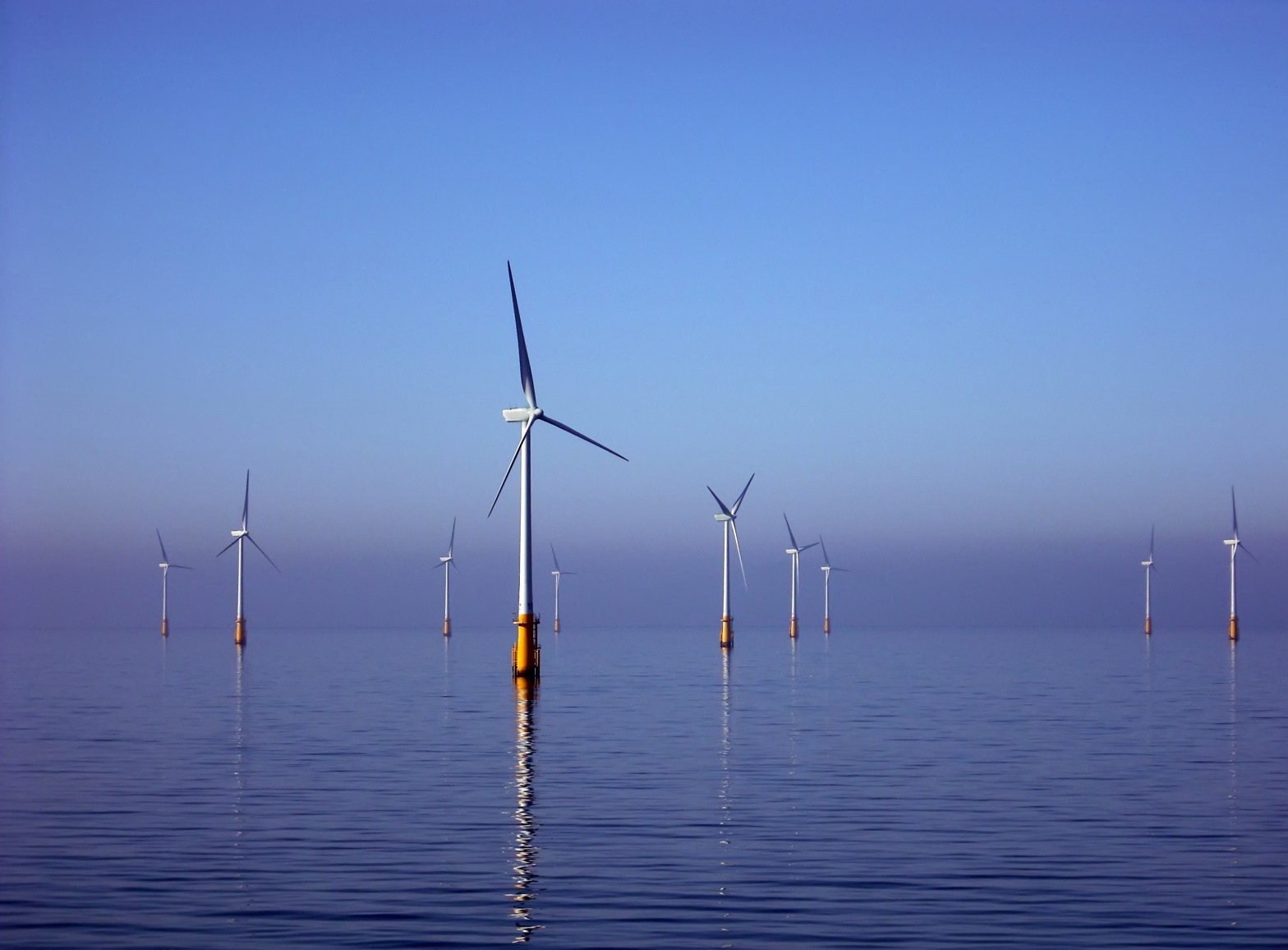
Image: Barrow_Offshore_wind_turbines.jpg: Andy Dingleyderivative work: Papa Lima Whiskey 2 [CC BY-SA 3.0 (https://creativecommons.org/licenses/by-sa/3.0)%5D